Fluorimetry
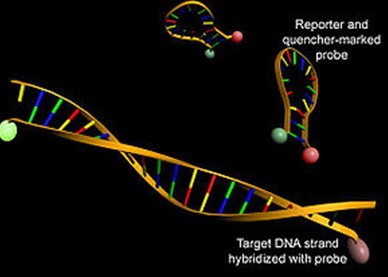
Real-time PCR instruments monitor the progress of PCR, and the nature of amplified products, by measuring fluorescence.
The range of different fluorescent labels that can be monitored, the precision with which they can be measured, and the ability to discriminate signals from different labels, are relevant performance characteristics.
By using an instrument with sufficient optical channels and extensive assay optimisation, up to 7 separate targets can be simultaneously quantified in a single PCR reaction. However, even with extensive optimisation, the effective dynamic range of such multiplex assays is often reduced due to interference between the constituent reactions.
The noise in fluorescence measurements has an impact on the precision of qPCR. It is typically a function of excitation source intensity variation, detector noise and mechanical noise. Multi factorial analysis has suggested that the contribution of mechanical noise is the most important factor, and that systems with no moving parts in their optical paths are likely to provide improved quantitative precision.
In addition, when performing high resolution melting analyses, one factor that impacts the sensitivity of heteroduplex detection is fluorimetric precision.
Therefore the number of optical channels and the level of noise in fluorescence measurements are also important performance characteristics of real-time PCR instruments.